
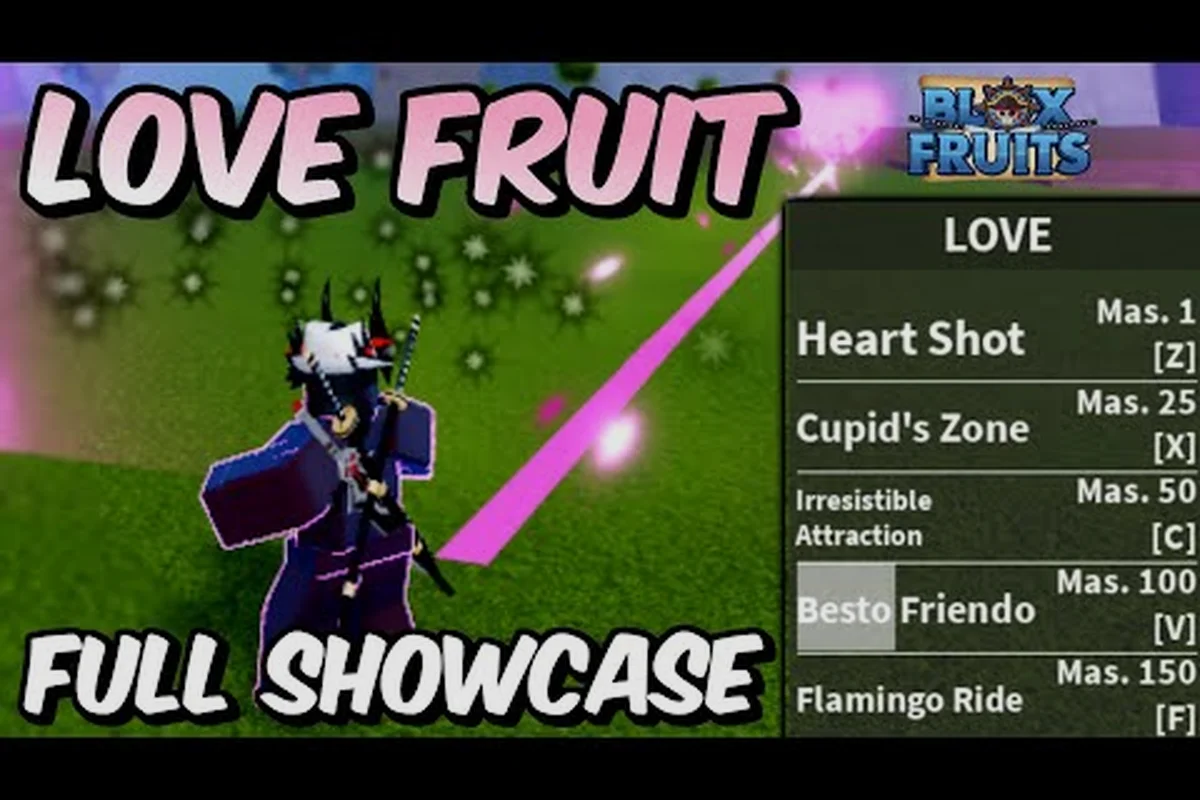
Blox Fruits Love Fruit is more useful after its rework because its revised kit combines dependable healing, close-range control, and a practical awakening path. The balance still depends on mastery, so the guide below compares its real value with Eagle, Diamond, Light, Rubber, and Ghost Fruit.
Blox Fruits Love Fruit Overview After the Rework
The reworked Blox Fruits Love Fruit sits in an interesting middle ground: it does not dominate every activity, but it gives players several dependable tools for solo progression. Its strongest qualities are sustain through recovery, consistent close-range pressure, and a kit that can remain useful when a boss changes position unexpectedly. The community showcase linked below demonstrates the current skill presentation, while balance can shift with future updates.
Community discussion also supplies a useful rule for judging any fruit: for farming, kill speed per rotation matters more than a theoretically stronger ultimate, while in PvP, a reliable stun or grab often creates the first combo opportunity. Love Fruit performs best when players understand that balance rather than assuming it belongs in one fixed tier.
| Player goal | Love Fruit value | Main limitation |
|---|---|---|
| Story progression | Strong sustain and close-range damage | Less efficient than specialized speed builds |
| Solo boss fights | Recovery creates room for repeated attacks | Some enemies punish close positioning |
| PvP pressure | Useful range control and burst potential | Requires mastery of timing |
| Beginner learning | Clear offensive and defensive roles | Awakening takes additional preparation |
| Endgame farming | Functional but rotation-dependent | Specialist fruits can clear enemies faster |
What Changed in the Reworked Kit
The most important change is not a single spectacular ability but the way the abilities work together. A player can apply pressure, create distance, recover lost health, and then return to the fight without feeling completely reset. That survival-to-counterattack loop makes the fruit particularly attractive for players who do not want to depend entirely on perfect spacing.
A community Love Fruit rework showcase provides a visual reference for the reworked abilities and their animations. Treat the video as a demonstration rather than a permanent tier guarantee, since developers can adjust damage, stamina costs, cooldowns, or control effects in later patches.
Core Strengths and Weaknesses
Love Fruit is particularly good at creating a workable rhythm in difficult fights. The recovery tools can absorb mistakes, the offensive skills can punish enemies that remain close, and the control effects discourage careless approaches. This makes it less dependent on perfect execution than a glass-cannon setup, although mastery still improves the timing of every rotation.
The drawback is mobility dependence. Although the kit can create space, it does not match the dedicated traversal and pursuit tools associated with Blox Fruits Light Fruit or the elastic movement of Blox Fruits Rubber Fruit. If a target never enters your effective range, extra health does not solve the positioning problem.
| Strength | Practical effect | Best scenario |
|---|---|---|
| Healing and recovery | Extends active time against strong enemies | Long boss rotations |
| Close-range control | Limits an enemy’s safe movement | Repeated boss attempts |
| Hybrid offense | Mixes burst with defensive checks | Mixed solo and PvP play |
| Awakening potential | Expands the ceiling for experienced players | High-level farming and duels |
| Flexible cost profile | Supports both cautious and aggressive play | General-purpose progression |
Love Fruit Skills, Control, and Farming Value
The best way to understand Blox Fruits Love Fruit is through its ability categories rather than individual animation names. Players should separate damage, control, recovery, and movement because each contributes differently to clear speed and survival. A skill that deals moderate damage but creates space may be more valuable than a heavier hit if it prevents incoming damage.
Recovery and Pressure
Healing matters most when the player understands when not to use it. Waiting until health is dangerously low can leave no room to reposition, while activating recovery too early may waste the effect at a moment when a well-timed attack or defensive check would be better. The practical rule is to recover during a lull, then use the restored health to secure one meaningful counterattack.
The same rule applies to control skills. If an ability briefly stops or redirects an enemy, the follow-up should be chosen before the skill is cast. Combining a control check with a recovery effect can create a safe opening, while pairing it with a heavy attack creates more burst. This ability sequencing explains why two players can use the same fruit with very different results.
Rotation Speed for Quest Enemies
Farming value depends on how quickly a complete sequence removes a target while preserving enough resources for the next enemy. Love Fruit can perform efficiently when its control effect creates a free damage window and its recovery prevents one mistake from breaking the rotation. However, a slow setup or missed punish can add time that a faster fruit would not need. Players should compare three measurable outcomes instead of relying on community tier labels:
-
Time to first damage: How quickly the fruit reaches an enemy.
-
Damage per rotation: How much useful damage lands before the enemy moves or attacks.
-
Recovery overhead: How much of the rotation is spent healing rather than attacking.
| Farming measure | Excellent result | Average result | Poor result |
|---|---|---|---|
| Time to first damage | Nearly immediate | One reposition required | Several missed attempts |
| Damage window | Full punish available | Partial punish | No useful punish |
| Health preservation | Takes little damage | Minor healing needed | Frequent recovery |
| Repeat consistency | Smooth enemy-to-enemy flow | Occasional reset | Large damage spike |
| Stamina use | Supports extra actions | Just enough for the rotation | Ends the combo early |
For players comparing speed-oriented choices, Blox Fruits Eagle Fruit can feel faster when immediate mobility and hit-and-run pressure are priorities. Blox Fruits Diamond Fruit may suit players who favor a different close-range style. Love Fruit earns its place by offering recovery and control rather than chasing the highest abstract damage number.
Blox Fruits Love Fruit Compared With Eagle, Diamond, and Light
The closest comparisons are not identical substitutes because each fruit solves a different gameplay problem. Blox Fruits Eagle Fruit is associated with aggressive speed and pressure, Blox Fruits Diamond Fruit with close-range offense, and Blox Fruits Light Fruit with travel speed. Love Fruit overlaps with all three in some areas but centers the kit on sustain and control.
| Category | Love Fruit | Eagle Fruit | Diamond Fruit | Light Fruit |
|---|---|---|---|---|
| Primary identity | Recovery and control | Speed and pressure | Close-range power | Travel and momentum |
| Farming strength | Strong when played cleanly | Very strong with quick rotations | Strong at close range | Strong for mobility |
| Boss value | High sustain value | Excellent repositioning | Heavy punish potential | Fast approach and escape |
| PvP value | Rewards spacing and timing | Rewards fast openings | Rewards committed attacks | Rewards movement |
| Main weakness | Setup can be slower | Less forgiving in close fights | Risky against some enemies | Less capable in prolonged exchanges |
| Learning demand | Moderate to high | Moderate | Moderate | Moderate |
Eagle Fruit Versus Love Fruit
Eagle-style play favors rapid application of pressure and repeated movement. In an open arena, that approach can clear a target before it has time to recover. Love Fruit is stronger when a fight has several dangerous attacks, because its healing and control give the player more ways to survive mistakes.
The decisive question is simple: do you want to preserve health while working through a difficult boss, or maximize the speed of a routine clear? If survival is the priority, Love Fruit is more satisfying; if pure clear speed is the priority and the route is safe, Eagle Fruit can be the stronger choice.
Diamond Fruit Versus Love Fruit
Diamond Fruit emphasizes close-range force, while Love Fruit can keep a broader midrange rhythm by combining control with recovery. Against a stationary target, Diamond may deliver a more direct damage answer. Against a boss that changes distance, Love Fruit can be easier to sustain because it can create openings without requiring constant pressure.
Neither choice is automatically better. Diamond suits players who enjoy decisive melee rotations and know how to close distance safely. Love Fruit fits players who want a defensive layer, especially in solo content where repeated attempts have an emotional and time cost.
Light Fruit Versus Love Fruit
Light Fruit is the stronger specialist for traversal and pursuit, so it often wins fights where positioning is difficult. Love Fruit compensates with resource efficiency during damage windows. If you can reach the enemy quickly, Light may finish the encounter sooner; if the enemy reaches you and the battle becomes prolonged, Love may recover more total value.
Rubber and Ghost as Adjacent Choices
Blox Fruits Rubber Fruit offers elastic movement and bounce-based repositioning, making it appealing for players who prefer mobility-heavy fights. Blox Fruits Ghost Fruit emphasizes evasive pressure and can make opponents miss important openings. Both compete with Love Fruit indirectly: they reduce the need to heal by preventing damage, while Love Fruit repairs damage after prevention fails.
Awakening, Gacha, and Long-Term Progression
Awakening is one of the reasons Love Fruit remains worth pursuing despite its balanced position. As with other fruits, the awakened version is obtained through the fruit’s associated raid and becomes a distinct kit rather than a small numerical bonus. This matters because it gives invested players a new set of rotations instead of merely raising the same abilities by a few percentage points.
| Progression stage | What to focus on | Practical goal |
|---|---|---|
| Fresh fruit | Learn basic attacks and controls | Secure consistent quest clears |
| Regular mastery | Improve timing and stamina control | Reduce failed boss attempts |
| Raid preparation | Learn enemy patterns and counters | Preserve useful gear and consumables |
| Awakened form | Build a new rotation around the expanded kit | Farm and duel with greater consistency |
| Endgame use | Match the fruit to the activity | Avoid forcing one build everywhere |
A fruit comparison resource such as the Blox Fruits legendary and common fruits overview can help place Love Fruit among broader acquisition choices. However, a rare or impressive fruit is not automatically practical for every account. Playstyle fit matters as much as the fruit’s label, because a slower defensive kit can be more valuable than a higher-tier combo that the player cannot execute consistently.
Should You Spend Rolls on Love?
Love Fruit can be worth pursuing if you enjoy close-range fights, value recovery, and plan to keep using one versatile fruit across story, bosses, and PvP. If your priorities are instant travel, the fastest quest clear, or explosive ranged combos, spending rolls on it may disappoint you despite the rework. Before committing heavily, consider three points:
-
Do you enjoy learning a deliberate combo instead of relying only on movement?
-
Can your current gear support close-range damage and survivability?
-
Will you practice the awakened rotation rather than only using it for the first victory?
The overview of Blox Fruits awakening mechanics is useful for checking the broader unlock process. Players should still verify current raid requirements and reward details in game because unlock structures can change between updates.
Practical Builds for Quests, Bosses, and PvP
No single setup turns Love Fruit into a universally dominant build. A useful loadout supports the role you want without removing the strengths that make the fruit attractive. For general farming, favor enough damage to finish enemies quickly, modest durability to survive contact, and mobility to protect the rotation.
Solo Quest and Leveling Build
For steady level progression, use a short punish cycle: close distance safely, establish control, deal damage during the opening, and preserve enough health to repeat the sequence on the next enemy. Recovery should be treated as part of the rotation rather than an emergency button used after every mistake.
| Loadout slot | Suggested role | Reason |
|---|---|---|
| Weapon | Balanced damage or hybrid melee | Supports control windows without slowing movement |
| Accessory | Health or cooldown coverage | Balances repeated damage and skill timing |
| Hat | Mobility or stamina utility | Helps maintain the approach and retreat |
| Armor | Balanced defense | Avoids sacrificing too much attack speed |
| Secondary | Burst or utility | Covers gaps in the main rotation |
The Blox Fruits T Rex Fruit overview is a useful comparison when you want a sturdier early progression option, while Love Fruit offers a more specialized mix of recovery and control. Try to practice against weaker enemies before taking the same build into boss attempts.
Boss-Fight Build
Boss fights reward a more defensive plan because enemy attacks can break a damage race. Build around stamina reserve, enough defense to avoid severe hits, and a recovery habit that preserves resources. Keep the control skill ready for a dangerous phase, then use it when the boss’s pattern has finished rather than wasting it on harmless movement.
A player can improve consistency with the Blox Fruits Gravity Fruit guide, which highlights another control-focused approach to positioning. The point is not to copy another fruit’s gear exactly, but to identify which part of your setup lacks protection during a long boss rotation.
PvP Build
In PvP, Love Fruit players should prioritize spacing, reaction speed, and a practiced first move. Do not stay close simply because the healing tools are strong; healing cannot recover every mistake against a fast opponent. Use control to confirm a hit, use recovery after committing to a risky exchange, and keep enough mobility to avoid being trapped.
| Match situation | Better opening | Reason |
|---|---|---|
| Opponent holds distance | Control or quick reposition | Creates an opening without a blind rush |
| Opponent stays close | Burst after a controlled hit | Rewards the opponent for closing range |
| Low health after a trade | Recovery in safe space | Buys time to reset the exchange |
| Fast enemy with no easy catch | Defensive retreat | Avoids spending every skill on a missed punish |
| Long, even fight | Patient repeated checks | Stamina and health become decisive |
Frequently Asked Questions
Is Blox Fruits Love Fruit strong after the rework?
Blox Fruits Love Fruit is strong for players who value healing, control, and reliable close-range pressure. It is not automatically the fastest farming option, but its reworked kit can handle demanding fights when players manage stamina and create clean punish windows. Its value rises further after awakening and mastering the new ability combinations.
Is Love Fruit better than Eagle Fruit for farming?
Not in every situation. Eagle Fruit can be faster when mobility and rapid rotations dominate, while Love Fruit is more forgiving during difficult fights because recovery helps preserve the run. Choose Eagle Fruit for efficient clears and Love Fruit when durability, control, or repeated boss attempts matter more than maximum speed.
Does Blox Fruits Diamond Fruit outperform Love Fruit in close combat?
Diamond Fruit can be the stronger choice for players who want a direct close-range damage style. Love Fruit instead offers broader utility through recovery and control. Neither dominates every boss, because enemy movement patterns, the player’s gear, and mastery of the combo can outweigh a general comparison between the two fruits.
Should I use Light, Rubber, or Ghost Fruit instead of Love Fruit?
Light Fruit is strongest for fast travel and pursuit, Rubber Fruit for elastic movement and bouncing repositioning, and Ghost Fruit for evasive pressure. Love Fruit is better when you want to sustain close fights and punish mistakes. The best alternative depends on whether your priority is travel, movement, or survivability.
Is awakening required to make Love Fruit worthwhile?
No. The normal kit can already support steady story progress and boss attempts. Awakening is worthwhile for players who want a new rotation and plan to keep the fruit long term. Confirm the current raid and reward requirements in game, because those details can change as updates arrive.