
A Blox Fruits trade scam often begins with a convincing offer, so checking both sides before confirmation can prevent you from giving away a valuable fruit. Learn the warning signs, compare both sides, and never accept a rushed deal.
What Counts as a Blox Fruits Trade Scam?
A trade scam is any attempt to make you believe you are receiving more value than you are actually giving away. The trick may involve a hidden item swap, a misleading fruit name, an altered offer, or pressure to confirm before the trade window updates. The damage can be severe because rare fruits and gamepass-adjacent items are difficult to replace quickly.
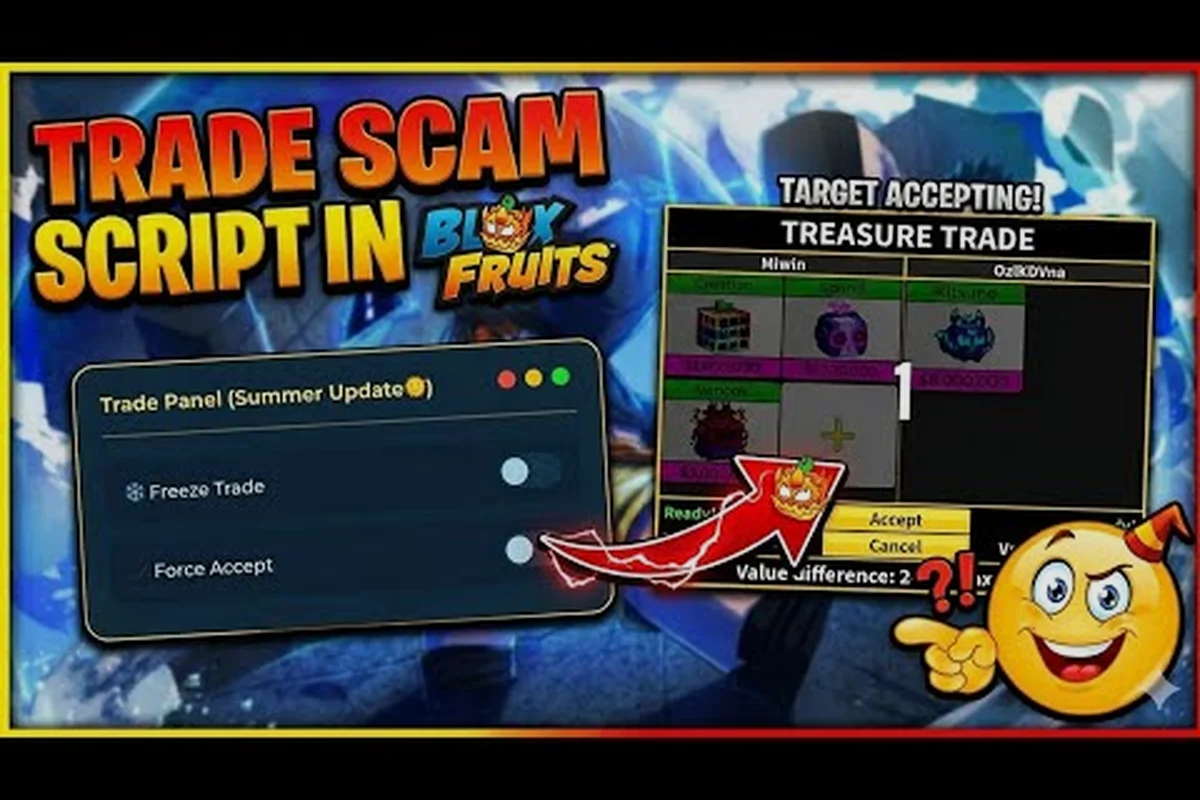
Community examples of a Blox Fruits trade scam commonly involve exaggerated promises involving Dragon, Dough, or Kitsune. Those names carry strong expectations, so a weaker fruit may be presented as a much better prize. A community trade-scam video illustrates why the safe habit is to inspect each trade slot individually rather than relying on the other player’s description.
| Red flag | What the scammer may say | Safe response |
|---|---|---|
| Rushed confirmation | “Confirm now before it changes!” | Stop and reread both sides |
| Unrealistic upgrade | “Two common fruits for a Dragon” | Check current demand and rarity |
| External promise | “I will send the real fruit afterward” | Refuse unfinished or promised trades |
| Description mismatch | “It’s the same fruit you saw earlier” | Verify the displayed name and appearance |
| Sudden offer change | “I improved the deal for you” | Review the new offer from scratch |
The central rule is simple: the visible trade window is the offer. Messages, titles, nicknames, private-server claims, and promises outside that window do not change what you will actually receive. A genuine trade may become dishonest at any moment, so the final confirmation must be treated as a fresh decision rather than the conclusion of an earlier negotiation.
Blox Fruits Trade Offers: Read Both Sides Twice
A Blox Fruits trade offer can be changed while the window remains open, which is why memory is not a reliable security method. The scammer may first display an acceptable item, then replace it immediately before you press confirm. Check your own outgoing item first, then the incoming item, and finally compare both sides against the agreed terms.
The interface does not offer a built-in guarantee that a trade is fair, so the player must perform the final review. This makes each Blox Fruits trade offer a three-stage check: identify what you give, identify what you receive, and compare whether the exchange makes sense. If any detail is unclear, leave the window open or exit before confirming.
| Review step | Question to ask | Common failure |
|---|---|---|
| Outgoing slot | Is this exactly the fruit I intended to trade? | Accepting a swapped starter item |
| Incoming slot | Is its rarity and name what the other player promised? | Trusting chat instead of the displayed item |
| Value comparison | Is the exchange reasonable for both sides? | Assuming one famous fruit means a fair deal |
| Final state | Has either side changed since the last review? | Rushing through a live update |
Do not rely on the visual impression of a high-level fruit alone. A fruit may have a recognizable name, but the item’s condition, demand, and tradeability still affect its value. For broader valuation habits, the Blox Fruits trading guide explains how to compare win, fair, and lose offers rather than treating every flashy fruit as a jackpot.
Check the Fruit Name Instead of the Memory
Names such as Dragon Fruit can be used as bait, but the displayed trade slot is the reliable source. Look for the full fruit name in the offer and compare it with the fruit being discussed in chat. Do not assume that a similar silhouette means the same fruit, especially when multiple fruits share the same visual color palette or elemental theme.
A second pass should compare the fruit’s rarity label, not merely its appearance. If the incoming offer is supposed to be a Dragon fruit but appears in a different rarity band, leave the trade unfinished. The best response is not to accuse the other player immediately; simply correct the offer or cancel before confirmation.
Look for Last-Second Changes
The most dangerous moment is often the final second. A scammer may wait until you are ready to confirm, then update one slot, shorten the timer, or begin counting down from ten. Treat every visible update as meaningful. If the incoming side changes after your first review, return to step one and inspect the entire offer again. Community reports on freeze-trade and item-swap videos emphasize that rushing is the main vulnerability in many cases. Slowing down and rereading every slot prevents a scammer from relying on a quick click or your confidence in an earlier arrangement.
How to Avoid Scams by Valuing Both Sides
Learning how to avoid scams requires more than recognizing suspicious behavior. You also need enough value context to recognize a bad exchange before it reaches the confirmation screen. The central problem with an obviously unfair trade is that the victim may not know the market well enough to identify the imbalance.
Start with rarity, demand, and availability. A fruit that is difficult to obtain may justify a premium, while a common fruit can still be useful if the other side needs it. Demand changes as the player base and game systems evolve, so old screenshots and fixed calculators should be treated as historical references rather than current guarantees.
| Value factor | Why it matters | Question to check |
|---|---|---|
| Rarity | Scarcer fruits generally have more replacement difficulty | Is this genuinely hard to obtain? |
| Demand | Buyers determine whether a fruit can be traded again | Is the fruit useful to many players? |
| Utility | Combat value supports lasting interest | Does it help bosses, leveling, or PvP? |
| Availability | Common items are easier to replace | Could I farm another one soon? |
| Trade history | Recent offers reveal changing preferences | Are comparable trades improving or declining? |
When evaluating Blox Fruits rare fruit values, separate the fruit’s current power from its market demand. A strong fruit with little interest may be harder to trade than a less powerful but highly sought-after item. This is why value lists are starting points, not final answers.
Mythical and Mythical-Class Fruit Values
The mythical fruit value depends on several changing factors, including the fruit’s combat profile, availability through dealers and events, and how many players want it. Do not assume every fruit in the same rarity band has the same market price. One fruit can be valuable because it is rare; another can be valuable because it remains popular even when supply increases.
For practical comparison, the Kitsune fruit value breakdown can show how rarity, demand, and utility interact. Apply the same method when comparing a mythical fruit with another high-tier item. Check both the fruit you receive and the fruit you surrender, because a famous name on one side does not make a lopsided trade fair.
Dragon Fruit Value Checks
Dragon has a strong reputation, so the Dragon Fruit value is often overstated by dishonest sellers. Compare the incoming Dragon against your own fruit using current rarity, demand, and availability—not just the promise that the trade is “once in a lifetime.” If the other player offers a lower-value item in return, added rarity on their side should be reflected by something meaningfully better on yours.
No fixed number can remain accurate forever. As of the date of this guide, treat current trade offers and community-observed demand as the best live references. If no recent examples support the proposed exchange, label it uncertain rather than pretending a stale price guarantees a fair deal.
| Situation | What it may indicate | Action |
|---|---|---|
| One Mythical fruit for several common fruits | Potential rarity inflation | Compare utility and demand before accepting |
| Dragon offered for a recent or limited fruit | Possible overvaluation bait | Verify both current value trends |
| Equal rarity but different appeal | Demand may differ | Check recent trade interest |
| Seller cannot explain the valuation | Weak or deceptive offer | Do not confirm |
Rare-Fruit Acquisition and Trade Readiness
A player can still be responsible for obtaining valuable items without treating every high rarity as a guaranteed prize. Understanding how to get rare fruits reduces desperation, which scammers often exploit. They may suggest that a bad trade is necessary to acquire a stronger fruit quickly, using FOMO to override your normal checks.
There are several legitimate collection paths: natural fruit spawns, dealer stock, limited-time events, boss rewards, and trading with other players. Each source has different availability constraints, so the correct method depends on your level, schedule, and current server rotation. The complete Blox Fruits fruit list can help you separate spawnable fruit from special or event-based rewards.
| Source | Main advantage | Main limitation |
|---|---|---|
| Natural spawn | Potentially efficient when monitored | Availability and spawn timing vary |
| Fruit dealer | More predictable stock | Costs Beli and depends on restock |
| Limited event | Access to special rewards | Time-limited availability |
| Boss reward | Direct progression reward | Requires preparation and repeated attempts |
| Player trade | Wide variety of items | Requires careful valuation |
Avoid Desperation Trades
Desperation makes a scam easier because the victim stops applying the same rules they would use on a casual item. If you urgently need a mythical fruit for progression, do not let a seller dictate the deadline. A legitimate opportunity can wait for proper verification; an illegitimate one often cannot.
Know what you already own before negotiating. A strong trade can improve your build without making you dependent on a promised future exchange. If the only path to your desired fruit involves giving away valuable items for an unverified return, the potential trade carries more risk than the reward.
Storage and Notification Readiness
Knowing where your fruits are stored reduces the chance that you accept a confusing offer merely to clear inventory. A fruit-management overview covering fruit storage and notifier alerts can help you organize rare items before entering a negotiation. Reliable records also make it easier to identify whether you actually received what was agreed upon.
Do not keep valuable inventory in multiple accounts that are easy to confuse. Record the exact fruit name, its rarity, and the intended trade partner. This simple preparation makes disputes less likely because both sides begin with the same expectations.
Scam Red Flags and Safe Trade Habits
A scammer may be new, experienced, friendly, or impatient. Character impressions are less reliable than transaction checks. Focus on actions that can be verified: the displayed offer, the item names, the timing, and whether the other side changes without explanation.
| Observed behavior | Likely tactic | Countermeasure |
|---|---|---|
| Constant urgency | Prevents deliberate review | Set a personal pause rule |
| Mentioning a huge value repeatedly | Anchors your expectations | Value both sides independently |
| Adding harmless filler items | Distracts from one bad slot | Review each slot separately |
| Changing the incoming fruit | Last-second item swap | Restart your review after any change |
| Asking for a secret code or extra item | Off-platform payment scam | Decline immediately |
| “Trade proof” image | Stale or fabricated evidence | Require live in-game confirmation |
The safest trade habit is to compare, pause, and confirm. Compare both sides, pause long enough to think without chat pressure, and confirm only when the current screen is correct. If the trade cannot survive a short delay without the seller becoming angry, that pressure itself is evidence that something may be wrong.
Separate Trust From Verification
Trusting another player’s reputation may be reasonable socially, but it does not verify the trade. Reputation can be faked, borrowed, or irrelevant to the current offer. Even a trusted friend can make a mistake, especially when both sides contain several items or when the interface changes mid-session.
Ask the other player to state what they believe they are offering and receiving, then compare that statement with the screen. If the chat and interface disagree, trust the interface and cancel. This practice also prevents honest misunderstandings from escalating into conflict.
Keep Evidence When Something Goes Wrong
If a suspicious offer appears, capture the relevant trade details and note the time, platform, and username. However, do not publish private information or encourage risky retaliation. The practical priority is to stop the trade, secure remaining items, and report conduct that violates the game’s rules through appropriate channels.
Records help when the same account approaches you again or when a dispute requires review. They also support a cleaner account-security response if someone has obtained personal information. Never send passwords, codes, or payments to “unlock” or “guarantee” a trade.
A Reliable Blox Fruits Trade Verification Routine
A consistent routine reduces the chance that emotion overrides judgment. Use the same sequence every time, even when a fruit looks familiar or the seller seems trustworthy. The routine should take only a minute, but that minute can protect an item that takes much longer to replace.
Spotting a Setup Early
Decide your price before entering the trade. Write down the lowest acceptable value and the exact item you expect to receive. If the other player proposes a different arrangement, evaluate it independently instead of treating their suggested value as the market price. Preparation reduces both overpayment and accidental acceptance.
When the Trade Window Opens
Inspect each slot from left to right, then from right to left. The second direction is useful because repeated inspection in the same order can make a changed item seem familiar. Confirm the outgoing item, the incoming item, and any additional goods before touching the final button.
At the Moment of Confirmation
Check that nothing changed after your final review. A timer does not override the need for accuracy. If either side is uncertain, cancel and restart. A scammer may react with surprise or insult, but a legitimate trade should tolerate a few seconds of verification.
After a Successful Trade
Open your inventory and confirm that the expected fruit arrived. Do not rely solely on the success message. If the item is missing or different, record the details immediately and report the issue. This final step also trains you to notice which item details you may have skipped during the negotiation.
Final Takeaway on Preventing a Blox Fruits Trade Scam
The safest defense is a repeatable verification process rather than perfect knowledge of every fruit price. Check the outgoing slot, check the incoming slot, compare both values, and restart the review whenever anything changes. Rare fruit value estimates can guide you, but the live display and current market conditions determine the actual offer.
A Blox Fruits trade scam is most successful when it combines pressure with uncertainty. Remove either factor by slowing down and documenting the offer. That simple habit protects valuable items while keeping honest trades straightforward. Remember that a legitimate exchange should remain understandable when both players have enough time to review it.
Frequently Asked Questions
How can I identify a Blox Fruits trade scam before confirming?
Watch for urgency, unexplained offer changes, exaggerated promises, and descriptions that differ from the trade window. Verify both sides immediately before confirmation, restart your review after any change, and cancel if the incoming fruit or total value remains unclear.
What should I do if an offer changes at the last second?
Cancel the trade and rebuild it from the beginning. A last-second change can be harmless, but treating it as routine creates risk. Confirm that both sides still match the new agreement and never confirm simply because a countdown or the other player is pressuring you.
Are extremely valuable fruit trades always scams?
No. A valuable fruit can be part of a legitimate trade, but the famous name alone does not make the exchange fair. Compare both sides using current rarity, demand, availability, and recent player-reported offers before deciding whether the terms are reasonable.
Can I verify a trade using chat messages or screenshots?
Treat messages and screenshots as context, not proof. The live trade window shows what each side is offering at that moment, so confirm the current slots directly. Old screenshots can be manipulated or may show an offer that is no longer active.
Should I accept a trade from a player with rare fruits and good gear?
Good gear and rare items do not prove honest behavior. Evaluate only the current offer using the same verification routine you would use with an unknown player. If both sides make sense and nothing changes, the trader’s appearance and inventory do not need to influence the decision.