
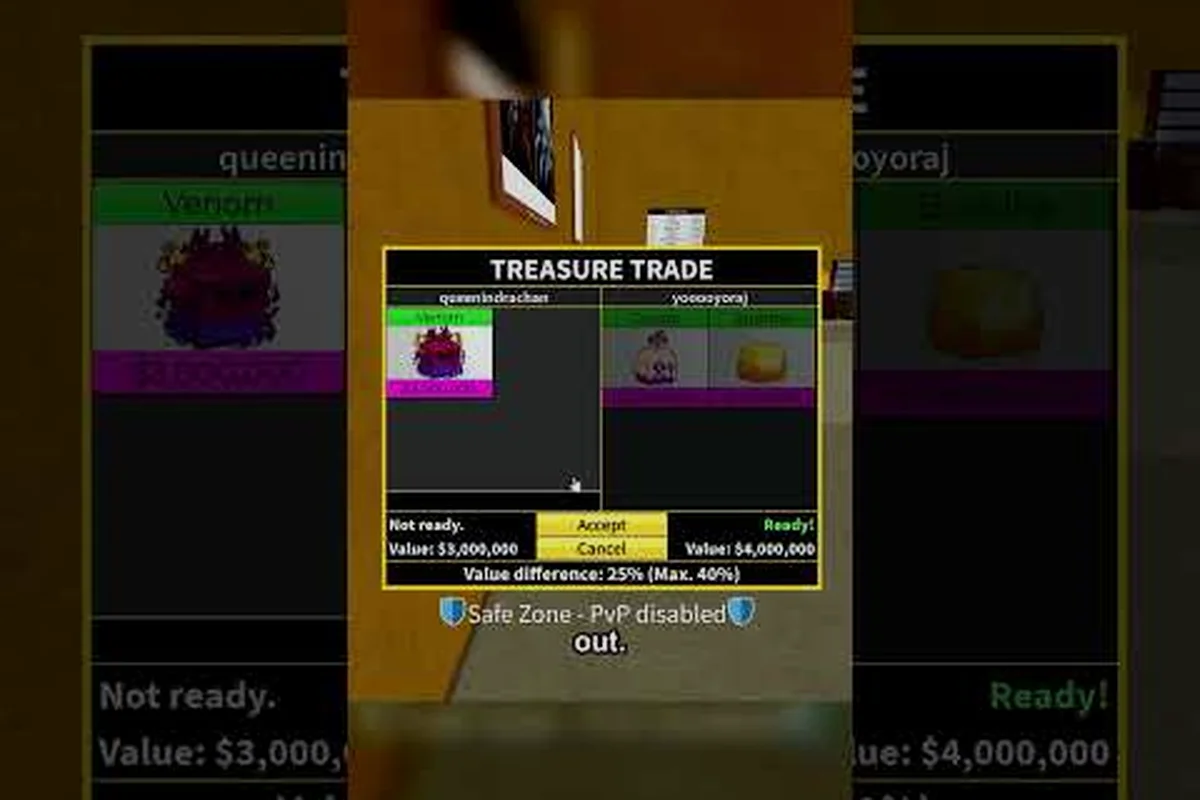
The Blox Fruits trade values update matters because a fruit’s price can change with rarity, current demand, recent server activity, and whether stock is moving through the Blox Fruit Gacha. For example, a commonly traded fruit may gain value if many listings are bought up, while a rarer fruit can lose value when new stock appears. Compare recent WFL prices, notice the direction and speed of demand, and check whether the same offer has been sitting unclaimed for long before treating its listed value as the real market price.
What Changes in Blox Fruits Trade Values?
Blox Fruits values are not fixed prices set by the game. A fruit may become more valuable when it becomes scarce, less valuable when many players are farming it, or easier to judge when collectors begin targeting it. Understanding the market cycle helps explain why two players can look at the same fruit and reach very different conclusions.
The current Blox Fruits trade values update should be treated as a community snapshot, not an official exchange rate. Player-maintained lists are useful because they capture live behavior, but they can lag behind balance changes, events, and sudden changes in interest. Always quote the date of a list and identify whether its creator uses a demand-based system, a scarcity-based system, or a mix of both.
| Value signal | What it measures | Practical question |
|---|---|---|
| Base rarity | The fruit's general category | How difficult is this fruit to obtain? |
| Current demand | How many players want it | Are collectors actively requesting it? |
| Recent supply | How easily players can farm it | Has availability increased lately? |
| Ability utility | How useful the moves feel in play | Would gameplay justify a premium? |
| Prestige value | Status associated with the fruit | Does it carry collector appeal? |
This framework explains the purpose of the Blox Fruits trade values update: it gives traders a consistent way to compare demand instead of relying on one person's memory. The broader Blox Fruits trading guide can help you connect those prices with offer structure, trading windows, and fruit categories.
Why Community Lists Change
A value list becomes outdated when the player economy changes. If a popular fruit appears frequently through dealers, its supply may rise and buyers may become more selective. Conversely, a fruit that becomes harder to acquire can gain value even if its abilities did not change. Events, new players, and shifts in high-level farming priorities also affect the pool of potential buyers.
The useful part of a Blox Fruits trade values update is therefore its reasoning, not merely its ranking. A list that says why a fruit increased in value is more informative than a bare tier label. Check the date, look for demand signals, and compare several community sources whenever the proposed price is high.
WFL Ratings and Their Limits
A Blox Fruits WFL means win, fair, or lose: one side's proposed goods are judged better, equal, or worse than the other side's. It is a quick comparison tool, not a substitute for manual valuation. A single WFL can look fair while one side quietly gives up a fruit that has recently become much more desirable.
| WFL result | What it usually means | Before accepting |
|---|---|---|
| Win | The offer strongly favors the proposer | Check each item and hidden demand changes |
| Fair | Both sides appear approximately equal | Recalculate after applying current demand |
| Lose | The offer strongly favors the other side | Ask why each side is valued differently |
For large packages, break the trade into individual lines. If one side offers three common items and the other offers one disputed fruit, calculate the fruit first and then price the remaining group separately. This approach reduces the risk of a bundle distortion.
Blox Fruits Trading Values Explained
A credible valuation separates a fruit's baseline worth from temporary market pressure. The baseline reflects rarity and general desirability, while temporary pressure comes from supply, current player requests, and short-lived collecting trends. Keeping those layers distinct makes a Blox Fruits trading values explained framework much easier to apply.
Base Value and Demand Value
Start with the fruit's category, then ask whether its current price premium comes from demand or supply. A fruit with strong ability utility may retain value even when supply is healthy, while a flashy but less useful fruit may fall quickly if many collectors own it. This is why copying a number without understanding the reason can lead to an unbalanced trade.
| Valuation layer | Example evidence | Adjustment |
|---|---|---|
| Rarity baseline | Rare category or difficult acquisition | Start above common-stock value |
| Utility premium | Strong combat performance or desirable control | Add a moderate premium |
| Demand spike | Frequent collector requests and recent interest | Increase temporarily |
| Supply surplus | Frequently available or widely farmed | Reduce expected value |
| Prestige premium | Collectors value ownership or display | Add only if confirmed interest exists |
This separation is especially helpful when learning Blox Fruits trading values explained. It prevents collectors from inflating a fruit's worth simply because it is impressive while also preventing useful fruits from being undervalued just because they are easier to obtain.
Time and Date Controls
Every value estimate should have a time stamp. A price quoted without one may represent a completely different market. The same fruit can rise during a collecting event, fall after a farming method becomes common, or recover when newer players begin seeking it again.
Check three things before accepting a Blox Fruits trade quote: the value source’s publication date, whether its figure matches at least two recent community lists, and whether current trade discussions show genuine buyer demand. For example, a quoted price for a high-demand fruit should be supported by recent offers from actual buyers, not merely repeated dealer asking prices; otherwise the number may reflect an outdated or inflated market estimate.
-
Freshness: Identify the publication or update date of the value source.
-
Consistency: Compare the estimate with at least two other recent community lists.
-
Market activity: Search recent trade discussions for actual buyer interest, not only dealer availability.
A dated snapshot is useful even when it becomes outdated later. It records what players believed at a specific time and makes later comparisons possible. The same principle appears in the player discussion around this Blox Fruits trade race video, where changing player preferences and community re-rankings can quickly alter what a fair offer looks like.
How to Price Fruits for Fair Trades
Pricing a fruit is not a single calculation. It is a process of gathering signals, normalizing them, and deciding which signals deserve the most weight. The strongest method for Blox Fruits how to price fruits decisions is to use a three-pass valuation: baseline, current market, and offer context.
Pass One: Establish the Baseline
Begin with rarity and acquisition difficulty. Then consider whether the fruit's abilities have clear gameplay value. Do not use raw damage alone; control, mobility, durability, and practical usefulness in both solo play and groups can affect demand. A fruit with a lower damage number may still command a premium if its control or movement is more useful.
A simple baseline worksheet can look like this: assign each Blox Fruit a provisional WFL range using rarity, spawn availability, practical combat utility, and repeatable collector demand. For example, a common Storage Fruit with limited uses may sit near 500,000 WFL, while a rarely obtained Blox Fruit with strong mobility and crowd-control value may justify 10 million WFL or more. These are starting estimates, not fixed prices, so recent trade posts and confirmed buys should be checked before setting the final value.
| Baseline factor | Low observation | High observation |
|---|---|---|
| Acquisition | Common through normal progression | Difficult or limited to obtain |
| Combat utility | Limited practical use | Valuable across many situations |
| Collectors' appeal | Low buyer interest | Strong and repeated requests |
| Flexibility | Few viable uses | Multiple desirable applications |
Record that provisional WFL range before checking current trade posts, because one recent demand spike can distort the estimate without reflecting a fruit’s underlying scarcity or combat utility. For example, a Storage Fruit baseline near 500,000 WFL should not jump simply because several listings ask 700,000 WFL; compare those asks with completed deals, permanent-stock availability, and repeated collector requests. This comparison helps separate genuine Blox Fruits value growth from temporary seller scarcity or unfinished trades.
Pass Two: Check Current Demand
Next, look for evidence of active buying. A fruit named in several recent requests is generally easier to price than one that merely appears in a tier list. Pay attention to the quality of the evidence: a completed trade is stronger than an unanswered offer, while a completed trade is stronger than an unanswered offer, while a completed trade is stronger than an unanswered offer.
Community reports should be treated as signals rather than universal facts. They can reveal what players are asking for, but they do not guarantee that your specific offer will find a buyer at the same rate. The community pricing video illustrates why large trades deserve item-by-item review instead of relying only on the overall label assigned to them.
Pass Three: Value the Entire Offer
An offer can change the value of its parts. If both sides include several fruits, a common fruit may have more bargaining room than a rare one because it gives the other player additional selection. Likewise, a package can be attractive when it contains a desired fruit plus useful filler, even if the filler has a low standalone value.
A multi-fruit offer should be valued as a package rather than by adding each fruit’s standalone price. For example, if a trader offers a Buddha fruit plus two low-demand fillers, the package may still outperform a single mid-tier fruit because the Buddha fruit supplies most of the value while the fillers improve the deal’s usability. That distinction helps explain why a rarer fruit does not automatically create the strongest trade when the other bundle offers greater overall utility.
-
Price the most disputed fruit independently.
-
Group the remaining items into common, mid-tier, and premium categories.
-
Adjust for demand using recent completed trades.
-
Add a small convenience adjustment when one side offers a smoother, more desirable bundle.
-
Run the WFL check twice, once from each side's perspective.
This comparison is the practical heart of Blox Fruits trade values update guidance because it turns fruit demand, bundle utility, and recent completed trades into a price that can be explained, challenged, and corrected. For example, if a Buddha fruit is paired with a low-demand filler, check whether the package’s extra convenience justifies its premium over a mid-tier bundle; if recent demand for Buddha has fallen, the rarer fruit should not automatically outweigh the stronger offer. Recording the inputs and final WFL estimate creates a repeatable baseline for negotiating instead of relying on instinct alone.
Blox Fruits WFL and Demand-Based Pricing
Demand-based pricing treats recent player behavior as the leading signal. In this model, a fruit's value rises when more players request it, falls when it becomes common in offers, and holds steady when supply and interest are balanced. The method is especially useful for comparing a rare item against several lower-tier fruits.
Building a Demand Score
A demand score does not need complex mathematics: assign the weights shown in the table to recent Blox Fruits trading signals, then total them to compare fruits such as Blizzard, Dough, or Blox Fruit. For example, one completed trade worth 3 points plus two specific requests worth 2 points each gives a 7-point demand reading. Keep the observation window short and review each entry before trading, because consistent scoring is more useful than an exact figure when availability, server demand, and player activity can shift the value of a Blox Fruits WFL item.
| Signal | Example | Suggested weight |
|---|---|---|
| Completed trade | A buyer accepts the fruit in a recent exchange | 3 points |
| Specific request | A trader lists that exact fruit as wanted | 2 points |
| Offer-side mention | Multiple offers include the fruit | 1 point |
| Old tier-list placement | Rank appears only in an older list | 0 points |
| Unanswered offer | Listing received no response | Do not count |
Community data should always be marked with a verification date. Values can vary by platform, server, and player activity, so a score supported by one old post should never outweigh several recent completed trades. If the source cannot be verified, label the estimate as uncertain rather than presenting it as a confirmed rate.
Comparing Uneven Packages
Suppose one side offers a single fruit and the other offers two lower-value fruits. Start with the single fruit's current demand-adjusted price, then compare the combined lower-value side. Do not simply count fruits or assume that two pieces equal one premium piece.
| Package | Standalone view | Combined view |
|---|---|---|
| Fruit A | Rare, strong demand | Two common fruits may still be worth less |
| Fruit A plus filler | Premium value with less selection | Rare plus common can appeal to more buyers |
| Fruit B | High utility, weaker collector demand | Two utility fruits may match user preferences |
This is where Blox Fruits trading values explained becomes more than theory. Buyers value different things, and a package's appeal depends on which player might accept it. If a fruit has fewer known buyers but more gameplay usefulness, it may be easier to trade than its raw ranking suggests.
When Community Ratings Disagree
Two traders may disagree because they use different reference lists, focus on different buyers, or assign different weights to demand and utility. For example, one may classify a Blox Fruit by its WFL rarity while another values the same fruit by recent demand for specific stats such as Bloxia, Cyborg, or Dough. Rather than argue over one label, identify the discrepancy: record each trader’s rarity tier, target buyer, and preferred deal type, then compare those inputs to determine whether the disagreement comes from the fruit’s demand, supply, or item composition.
-
If one source values the fruit as common and another as premium, check acquisition rates.
-
If both sources agree on rarity but differ on price, examine recent requests.
-
If WFL differs from the item breakdown, the bundle probably contains different kinds of value.
For more advanced comparisons, the Kitsune fruit value reference demonstrates why individual fruit valuation needs dedicated analysis rather than one general price list. A Kitsune Fruit’s value can shift with its Blox Fruit rarity, whether it is paired with a usable Blox Fruit in the inventory, the availability of permanent or game-pass access, and the stats buyers need. For example, a rare Mutated Kitsune with valuable Cyborg or Dough may attract a different bid than a standard Kitsune, even when both share the same base name. Comparing those components helps explain why community ratings and current trade requests may diverge, while avoiding a misleading single-label price.
Trading Value Updates and Market Conditions
A Blox Fruits trade values update is most reliable when it tracks why the market changed. Rankings without explanations can conceal stale assumptions, while short update notes may ignore relevant context. Players should record both the date and the market condition behind any estimate.
Supply Signals
Supply increases when a fruit becomes easier to farm, when more players reach the relevant dealer tiers, or when an event temporarily floods the market with drops. It can also increase if experienced players shift away from older methods. A common fruit may still be useful, but it usually has less pricing leverage when buyers can obtain it readily. The fruit despawn and restock reference is relevant because availability and dealer behavior influence how players anticipate future fruit access. Although a despawn timer does not determine a trade value by itself, it can inform short-term supply expectations.
Collector and Utility Demand
Collector demand rises when players want a fruit for completion, prestige, or a specific combination. Utility demand comes from players who want the abilities for combat or farming. These groups can move at different times, so a fruit may remain desirable even if collectors temporarily stop buying it.
| Market condition | Likely effect | Trading response |
|---|---|---|
| Supply rises | Prices soften | Avoid premium asks unless demand is strong |
| Demand rises | Prices strengthen | Ask closer to the new range |
| Supply and demand rise together | Mixed | Compare recent completed trades |
| Both decline | Prices weaken | Prioritize a quick trade over holding out |
| Event creates a temporary spike | Prices become volatile | Use conservative, itemized pricing |
In a Blox Fruits trade values update, separate temporary market noise from lasting scarcity instead of assuming every price swing produces a permanent ranking shift. For example, if a Blox Fruit stock event sends demand above 1.5 times its normal level, completed trades may spike before returning to the established range. By contrast, a limited Stock spawn that removes supply for several days can keep the fruit’s value elevated even after collector and utility demand normalize.
Reviewing Your Own Inventory
Before making a trade, separate what you want to keep from what you merely want to sell. A fruit can have high market value but low personal urgency, while another may be less valuable yet better for your preferred play style. Price the inventory first, then decide whether a deal improves your account without locking away a fruit you actively need.
| Inventory goal | Pricing priority | Best decision |
|---|---|---|
| Immediate account upgrade | Liquidity | Accept a slightly lower premium for a usable offer |
| Long-term collecting | Prestige and rarity | Hold for a genuinely desirable fruit |
| One specific target fruit | Target demand | Include it as the centerpiece |
| Balanced inventory | Stable value range | Favor a fair, multi-item package |
This approach makes the Blox Fruits trade values update actionable. A market number describes what others may pay, but your decision should also reflect your goals. If safety practices are a concern, review the Blox Fruits trade scam guide before accepting unfamiliar offers or switching to a friend server.
Practical Methods for Verifying Current Values
Use a repeatable verification routine whenever the proposed value is high enough to matter. The routine should combine price lists with actual trade activity, because a list measures opinion while completed trades measure behavior. The more sources agree, the stronger your confidence, but every source still needs a date.
A Six-Step Verification Routine
The first step is to record the fruit, its ability level, and the exact offer. The second is to find at least two recently updated community references. The third is to identify recent completed trades involving that fruit or a close substitute. The fourth is to apply the current demand adjustment, and the fifth is to calculate the WFL from both sides. The final step is to pause before accepting if a major value-sensitive fruit is involved.
| Verification step | Evidence to collect | Stop condition |
|---|---|---|
| Record the offer | Every item and level | Missing item information |
| Check reference lists | Two dated sources | Sources conflict sharply |
| Review completed trades | Recent matching exchanges | No comparable trade found |
| Adjust for demand | Supply and request signals | Trend conflicts with stale list |
| Calculate WFL | Value for each side | One fruit carries most uncertainty |
| Final review | Risk and account goal | Deal depends on an unverified spike |
This routine prevents a detailed Blox Fruits how to price fruits discussion from becoming an endless search. You either have enough current evidence to make a reasoned decision or you know the offer is too uncertain to accept. Pausing is not failure; it is risk control.
Rating How Sure a Value Is
Attach one of three confidence labels to each estimated Blox Fruits trade value, using the latest value list alongside recent completed trades to judge the range. For example, if a Blox Fruit shows 120,000 Beli in current listings but recent completed trades cluster around 95,000–110,000 Beli, label it medium confidence because the listed and observed prices diverge. This makes the label reflect pricing uncertainty rather than merely the fruit’s rarity, helping traders avoid overpaying when demand for that Blox Fruit is weak or recently disputed.
-
High confidence: Multiple current sources agree, and recent completed trades support the range.
-
Medium confidence: Sources broadly agree, but completed trades are limited or the offer mixes several fruits.
-
Low confidence: The price relies on an old list, disputed demand, or a single recent event.
Low-confidence trades should usually be avoided when they would remove a valuable Blox Fruit, especially if its latest trade value is supported by only one recent sale or an outdated price list. A medium-confidence deal may be reasonable when the expected profit still improves your account after accounting for the uncertainty—for example, buying a fruit listed near 120,000 Beli when comparable completed trades sit around 95,000–110,000 Beli. A high-confidence deal is easier to accept without overpaying because several current listings and recent completed trades support the same price range, reducing the risk of buying above the fruit’s realistic market value.
Recording Market Changes
Keep a simple trade log with the date, offered items, agreed side, and reason for the estimate. Over time, this history becomes more useful than copying a static tier list. It reveals which communities you trade with, which values you consistently overestimate, and whether your preferred fruit has maintained or lost demand. The broader Blox Fruits demand list reference can support this process because supply and demand shift separately from raw rarity. When your log and the market reference disagree, investigate the reason instead of automatically replacing your records.
Frequently Asked Questions
How often should Blox Fruits trade values be checked?
Check values immediately before a major trade, especially when one side offers a rare or highly desired fruit. A general tier list can be checked weekly, but completed trades, current requests, and recent supply should be reviewed each time. Prices may move after events or farming changes, so a list that was accurate yesterday may already be stale today.
What does WFL mean in Blox Fruits trading?
WFL means win, fair, or lose and describes which side of an offer appears more valuable. It is a convenient starting label, but it does not explain why one side is stronger. Price every disputed item separately, apply current demand, and inspect the bundle because an overall rating can hide an unbalanced fruit on one side.
Are official Blox Fruits fruit prices available?
Blox Fruits does not provide a universal cash price for every fruit that remains consistent across all players. Available prices can vary with acquisition method, in-game events, and individual offers. Community-maintained data is therefore useful, but it should be treated as a dated estimate based on player activity rather than an official exchange rate.
Can a Blox Fruits trade value update make every offer equal?
No pricing method can guarantee that every offer is equal, but a current update and item-by-item review can expose obvious imbalances. Compare each important fruit against recent completed trades, check whether supply or demand recently changed, and calculate the package from both perspectives. If the main value-sensitive fruit remains disputed, waiting for a better offer is usually safer.
What makes a fruit gain value after an update?
A fruit may gain value when it becomes harder to obtain, more players request it, or its abilities become more useful. It may also appreciate during a temporary collecting trend, although event-driven gains can disappear quickly. The most reliable confirmation comes from recent completed trades, not an isolated tier-list placement or an old community estimate.